
How to Size a Solar Battery: A Complete Guide

Straight from the kitchen table.
There's no denying we're in the middle of a battery boom. Ever since the cheaper home battery rebate landed, I've been sitting down with customers just about every day to work out what they actually need.
And here's the funny thing. When someone tells me "I just want a battery," they've always got a picture in their head of what that battery is going to do for them. My job is to dig a bit deeper and find out what that picture actually is. Because I'll tell you what: ask five people what they want their battery to do, and you'll get five different answers.
The crazy part? It's not uncommon for people to spend $10,000 to $30,000 on a home battery setup, and sometimes I'm the first person who's actually talked to them about sizing. Not the second. The first. It becomes pretty obvious, pretty quick, that a lot of solar companies don't really have a handle on it.
So let me give you the same rundown I give customers. Get the sizing right and you've done half the battle before a single quote lands in your inbox.
What do you actually want the battery to do?
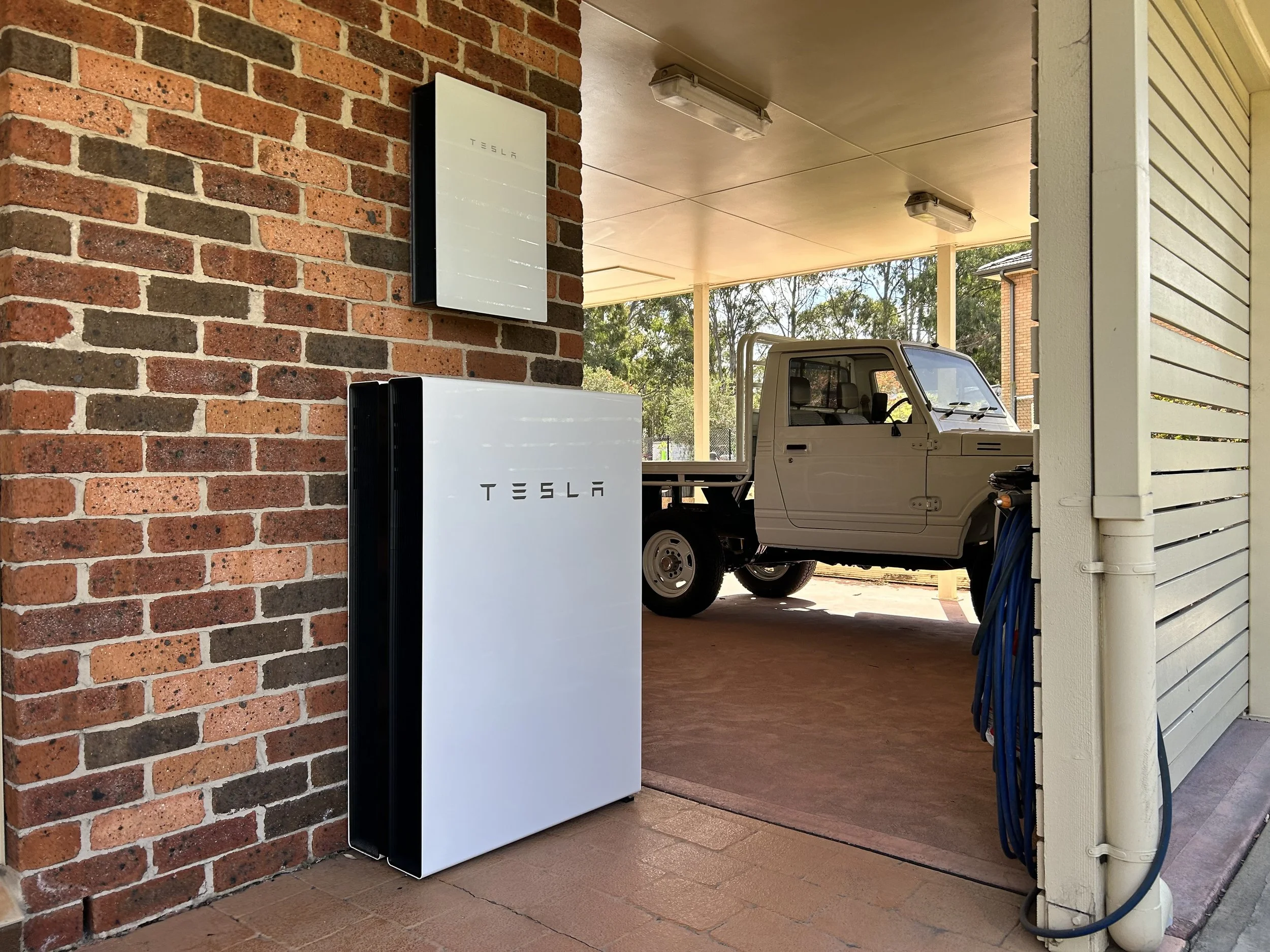
Nearly everyone wants the same headline result: a lower power bill. But how you get there changes the whole design.
Best bang for buck. You want the fastest return on investment and you're happy to still see a small bill.
Kill the bill entirely. You want that elusive $0 bill, which means a bigger system to carry you through the seasons when you're using more and generating less.
Get paid to export. You've heard from a neighbour or someone at work who's on a plan like Amber and gets paid by their retailer for dumping battery power back to the grid at the right times.
Blackout protection. You're on the fringe of the grid, you cop an outage every month or so, and you're sick of it. You want the fridges, the TV, the internet and the aircon to stay on so you never miss the footy.
Here's where I'll be straight with you, even though it might talk you out of spending money. If you live a few doors down from the hospital, you're on about the most stable stretch of grid there is. Paying extra for blackout protection you'll almost never use is the least fun way I can think of to spend your money. Know what you're buying and why.
Where I learned to size a battery properly
Quick bit of background so you know this isn't guesswork.
I cut my teeth designing off-grid solar systems. When you're off-grid, sizing the battery correctly isn't a nice-to-have, it's everything. If the battery runs flat, the power runs out. There's no network to fall back on. You are the grid. You learn very quickly to size things properly, because the alternative is a phone call on Christmas Eve from someone sitting in the dark.
That's the mindset I bring to every home battery. Now let's get into it.
The three sizes that matter
There are three numbers that make up your solar and battery setup, and each one is a lever. Pull them up for more capacity and features, pull them down to save on cost. There's no single right answer, just a few rules of thumb and a lot of room to build the system that suits you.
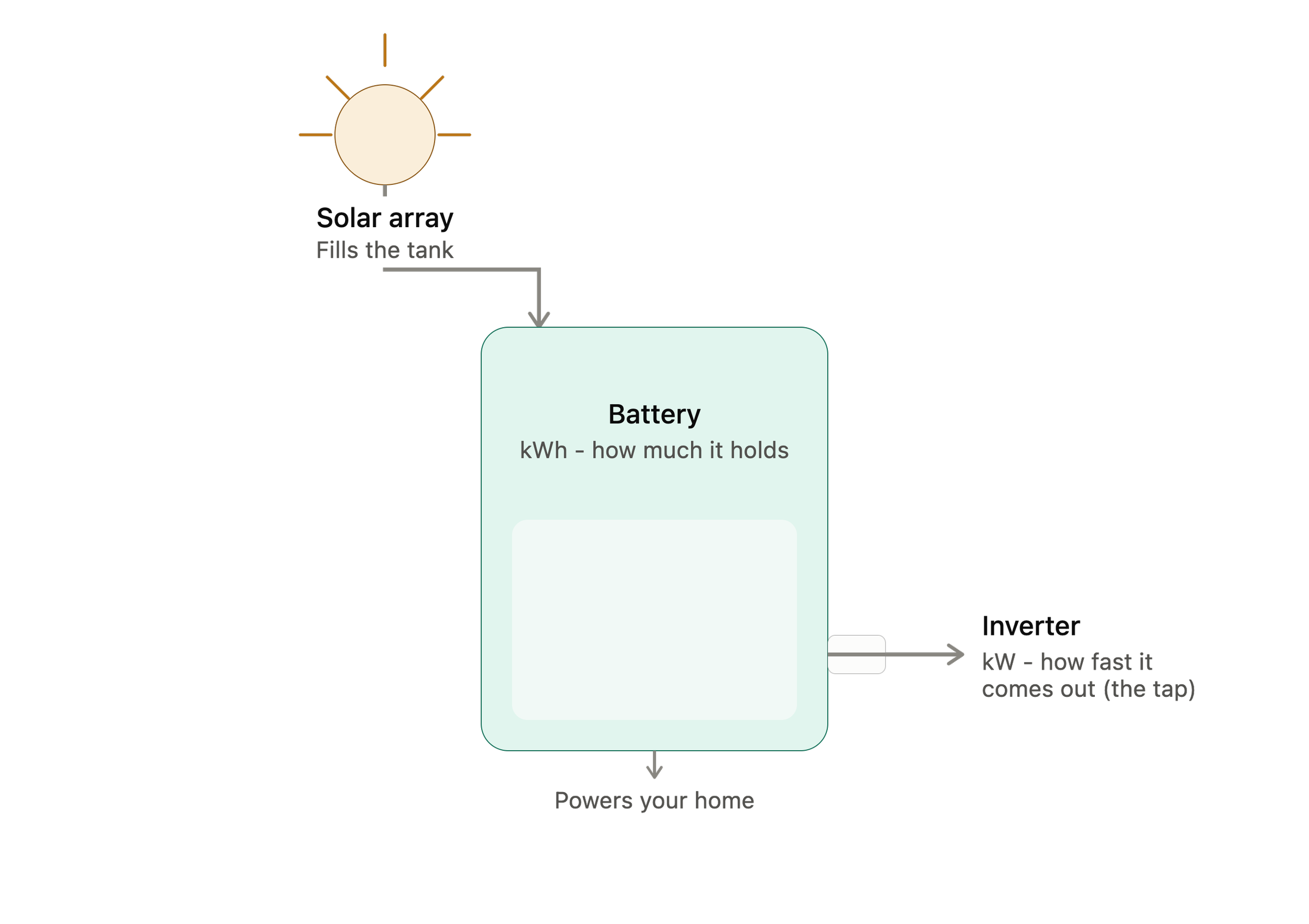
The three sizes are:
The kilowatt-hours (kWh) of the battery: how much energy it holds.
The kilowatts (kW) of the battery inverter: how fast you can get that energy in and out.
The size of the solar array: how many panels you've got charging it.
The easiest way to picture all this is a rainwater tank in your backyard, where all the water for your home has to come from that one tank.
The kWh is the size of the tank, or how much water you can store to get you through until it next rains.
The kW of the inverter is the tap on the tank, or how fast you can get the water out.
The solar array is how you fill the tank back up.
Most of the time, once I walk customers through this, they end up designing their own battery and we just facilitate it. So let's fill the tank.
How many kWh battery do I need?
Start with your average daily consumption. It's on your electricity bill, usually around page three, in a bar chart.
Some retailers (EnergyAustralia and Red Energy, for example) work the daily average out for you, which makes life easy. Others, like Origin, just give you the total kilowatt-hours for the month, so you'll need to do a bit of division. Say the little poem for how many days are in each month and you'll get there.
If you already have a decent solar system and you're just retrofitting a battery, you can treat that daily figure as roughly what you're pulling from the grid at night. A battery big enough to cover it will, on average, wipe out that purchase for the month. Buy nothing, and you're well on the way to the $0 bill.
If you don't have solar yet, that daily average is your usage across the full 24 hours, and a chunk of it happens during the day. So you don't need a battery as big as your whole daily figure. A rough starting point: assume about half your usage is daytime and half is night, and work off half the number.
Should you chase the $0 bill?
Honestly? No, chasing $0 usually isn't the smartest financial decision. It's more of a feel-good thing, and who am I to judge what you want to go for, as long as you know that's the trade you're making.
Here's why it costs more than people expect. Most homes use a lot more power in summer and winter than in spring and autumn, mostly because of heating and cooling. In my own place, an all-electric home with a family of four, the aircon is about 80 to 90% of our consumption. That's the big one.
So if you size the system to hit $0 in winter, when you've got the least solar and the highest usage, you'll need a battery and solar setup way bigger than you'd need the rest of the year. Size it for spring and autumn instead and you'll still cop a small bill in winter, but the whole setup is far more cost-effective.
That said, even after I explain all this, most people still say "nah, kill the bill, give me the big system." And that's completely fine. Your money, your call. I just want you making it with your eyes open.
Don't overthink the exact number
For the fellow energy nerds reading this who reckon average daily consumption is way too rough, you're welcome to download your meter data and track every individual day. Go for it, I won't stop you. But most people don't need that kind of analysis paralysis.
Batteries don't come in 1 kWh increments anyway. My current favourite, Sigenergy, comes in 9 kWh blocks. So if you're using somewhere between 10 and 18 kWh a night, an 18 kWh battery has you covered nicely. 18 kWh and 27 kWh are two of the most popular sizes going around, and both are cracking batteries.
What size battery inverter (kW) do you need?
Once you've got your tank size, we talk about the tap. The inverter kW is:
how fast you can get electricity out of the battery, and
how much you can run at once without pulling from the grid.
The question I ask here: do you want the battery covering you most of the time (say 90%), or do you want to go bigger so that under no circumstances are you ever pulling from the grid? Most people choose the latter.
A handy reference point: pretty much every kettle on earth draws about 2 kW when it's boiling. Single-phase battery inverters start at 5 or 6 kW and go up to 10 or 12 kW. Three-phase inverters we don't really do below 10 kW, and they can run all the way up to 30 kW.
Here's the reality though: most homes never pull more than 10 kW at once, and for the vast majority of the time they're sitting under 6 kW. The only homes that genuinely push past 10 kW are the big ones with a serious aircon system, a pool, a spa, or poor insulation that makes the aircon work overtime.
Rough guide:
Low-consumption single-phase home (quarterly bills around $500 to $750): a 6 kW inverter is sweet.
Higher than that on single-phase: step up to an 8 or 10 kW.
Three-phase: the small inverters cost about the same as the bigger ones, so there's little point going small. We usually start at 10 kW, which suits most people. Consider 15 kW if you want better blackout protection, because three-phase battery backup can be a bit less stable than single-phase (that's a story for another day). Going bigger than 15 kW doesn't add much to the price, so the main reasons to do it are strong blackout protection, or signing up with a plan like Amber and dumping a lot of power to the grid to save serious money.
One point most people miss: the inverter also controls how fast you can charge from the grid. If you've got a three-phase 20 kW battery and a plan with a free electricity window, you could pull up to 60 kWh from the grid in a three-hour free block. By any measure, that's a monster amount of juice for nothing.
Sizing the solar array
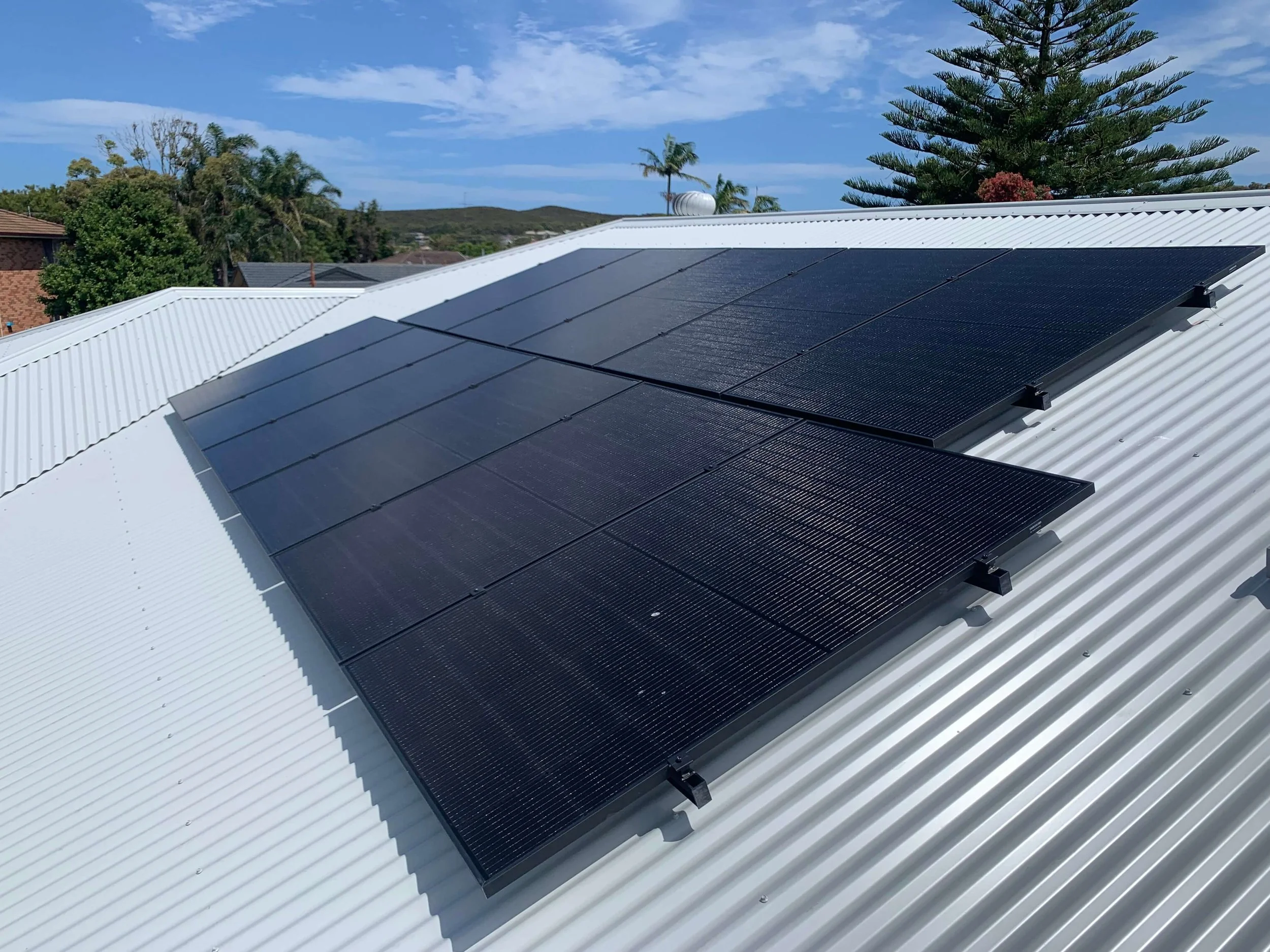
This is the one you can't read straight off your bill. You either get out the long-hand maths and bore yourself senseless, or you use proper solar design software that spits out the correct answer in minutes.
I use the software. It's where we place the panels on the roof, get the direction and tilt right, and model the output. North-facing gives you the most, but honestly, any panel is going to produce, and if you need the juice, more is more.
The thing to watch is winter production. As a rule of thumb, you generate about double in summer what you generate in winter. So when we design, we scope out June, July and August production carefully. Depending on how big your battery is (and mega batteries are wildly popular in 2026), there's a fair chance you won't fully charge it from solar alone through the depths of winter.
This is where those free electricity window plans have been a game changer. You can top the battery up from the grid during the free block, which is handy when solar's thin on the ground. I reckon these plans are here to stay, given how much cheap energy is floating around the grid during the day. Ideally you still size your solar to cover your nightly needs, because you never know when retailers will change their plans, but it's a great card to have up your sleeve.
The quick version
If you skimmed all that, here's the whole thing on one hand:
Check your bill and find your average daily consumption.
Decide what you're chasing: best return on investment, or the $0 bill.
Work out the kilowatt-hours you're trying to cover.
Take off the daytime usage (if you don't already have solar) to land on your night-time need. That's your target battery size (kWh).
Decide how fast you need to get power out of the battery. That's your inverter (kW), and it's a fun lever to play with for cost and features.
Get the panels on the roof to fill the battery up.
Keep a close eye on winter production, so you end up with a battery you love all year, not one that bugs you through the darker months.
The bottom line
Get the sizing right and you've genuinely done half the battle. You'll walk into the quoting process armed, you'll spot the companies who don't know their stuff, and you'll end up with a system built around what you actually want, not what someone's trying to sell you.
If you want a hand running through your own numbers, that's exactly the conversation I have every day. No pressure, no sales pitch. Just a sparky who'd rather you got the right size than the biggest invoice. [Get in touch with the team →]